by Brian Palmer
Historically Wales remained a wooded land for longer than most of the rest of Britain, and the importance of woods and trees was probably higher in Wales than elsewhere as they were places of sanctuary rather than commercial. As a consequence the Welsh language and many place-names are closely associated with the Welsh words for woods and trees. Since the Welsh language is still in use these words are easily understood today, whereas in England the Anglo-Saxon and Norse words within place names are less well understood as the language has changed.
This article looks at 3 main areas where Welsh and Woods are closely related:
It also looks at some examples of woods and English place-names for comparison.
Names of trees with other uses and meanings
🌳 The Welsh for a single tree is coeden, with the plural being coed, which is also used for wood and woods. The same principle applies to the names of trees, so the name for a single Oak tree is Derwen, and Derw for Oaks.
🧙 Derw is probably the root of Derwydd, the Welsh word for Druid, prophet or ‘wise man of the Oak tree’. The Oak tree was seen as providing access to higher wisdom. There is also a suggestion of a link between Druidry and Drwy, the Welsh word for the wren, the king of birds in Celtic mythology.
⛵ Gwernen is the Welsh word for Alder tree, and is also the word used for a bog or swamp, and the mast of a ship. The Alder grows in wet ground, tall and straight and gets stronger as it gets wet, so is ideal for use as a mast, or as piles in wet ground such as in Venice. Gwernen is also used for a stick, stave or the shaft of a lance.
🎭 Llwyfen is the Welsh word for Elm tree, and is also used to mean a wooden frame or platform, presumably because Elm wood was good for building these, and Llwyfan is the Welsh for stage.
💍 Collen is the Welsh word for Hazel tree, sometimes seen as Cyll. It is also used for a sapling or twig. The expression Cael Collen (to have a hazel twig) was used when an engagement was broken off.
🦊 Llwyn is the Welsh word for bush, shrub, or grove, and is the root of the word Llwynog, one of the Welsh words for Fox – meaning ‘of the grove’.
Welsh place names
Many Welsh place and house names are derived from woods and trees.
Perhaps the most common is Llan, which has come to mean church or village, but probably originally came from Llannerch, meaning a clearing in the woods, which was used by early Christians as a place of safety. These were usually the home of the founding saint of the parish. The founder of a new Llan was obliged to reside at the site and to eat only once a day, each time taking a bit of bread and an egg and drinking only water and milk. This lasted for forty days, Sundays excepted, after which the land was considered sanctified for ever. The names of many villages include Llan and the name of the saint, such as Llanfair – St Mary, Llanfihangel – St Michael, etc.
Many place and property names include Wern, which could be bog or Alder tree, or both.
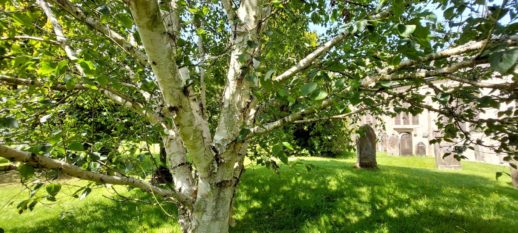
A good number include Bedw (or Fedw) meaning Birch – eg Bedw-Lwyn in Wrexham meaning Birch Grove.
Llwyn is also common, meaning Grove – eg Llwyn-Onn, again in Wrexham meaning Ash Grove.
Gelli is also the Welsh for grove, often of Hazel and appears in place-names such as Gelli-Aur in Carmarthenshire meaning Golden Grove.
And of course Coed, meaning Wood, probably the best known of which is Betws y Coed, meaning the prayer house (or lesser church) in the wood, with Betws derived from the English Bead-house (or Bede-house).
Of course there are many English place-names derived from Old English, Anglo-Saxon or Norse, but since those languages are no longer used the level of understanding is lower. Examples include:
- Hurst (hyrst) meaning wood or grove, eg Chislehurst
- Holt meaning small wood or thicket, eg Northolt
- Weald or Wold meaning upland woodland, eg Cotswold
- Shaw meaning small wood or thicket, eg Wythenshaw, meaning willow wood
- Hanger meaning hilly wood. The name is derived from the “hangers”: long, narrow remnants of ancient woodland clinging to the steep scarp slopes. Examples include Milking Hanger, Warner’s Hanger and Wick Hill Hanger in Hampshire.
- Dean or Dene – meaning a wooded valley – eg Rottingdean and Ovingdean in England and Deanston and Hassendean in Scotland.
- Grove comes from the Old English grāf – eg Bromsgrove – the grove of Broom bushes.
- Copse comes from coppice, originally meaning “small wood grown for purposes of periodic cutting”.
There are several English words that imply a clearing in the woods, which are included in place-names – Ley/Lea; Den; Thwaite. Wembley derives from the words “wemba” meaning prominent or conspicuous, and “leah” meaning a clearing or meadow. Tenterden derives from “Tenet Waraden,” meaning a woodland clearing belonging to the men of Thanet. My grandfather was a Micklethwaite, which is a placename meaning large clearing.
Wood itself comes from Old English wudu, or the earlier widu meaning tree, trees collectively, forest, grove; the substance of which trees are made. This may also be the origin of the old Welsh word for trees, namely Gwŷdd.
Coed and Gwŷdd – trees and knowledge
While Coed is the most common word used today for Wood in Welsh, Gwŷdd was formerly used in much the same way and has entered the language in many different ways. The definition of Gwŷdd in Spurrell’s Welsh dictionary of 1861 includes knowledge, frame of wood, loom, plough and trees, and the current GPC (Welsh University Dictionary) adds masts to this. So trees and knowledge and the use of wood are closely linked. Many tree-names include wydd.
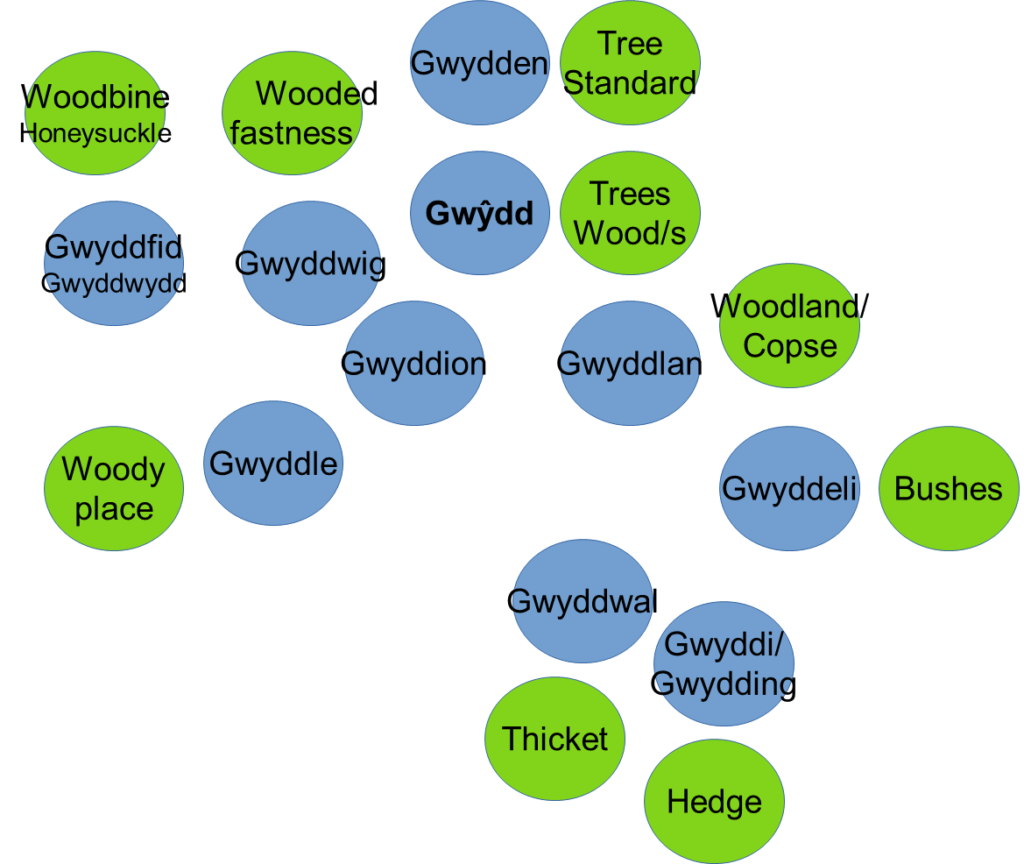
On the ‘wood’ side there are many words derived from Gwŷdd as shown here, most of which are not in current general use having been replaced by Coed-based words. The English word ‘withy’ may come from Gwŷdd.
And on the knowledge side there are many other words which are still in use including:
- Gwyddor – Alphabet or first principles (of learning)
- Gwyddoniaeth – Science or general knowledge
- Gwyddoniadur – Encyclopedia
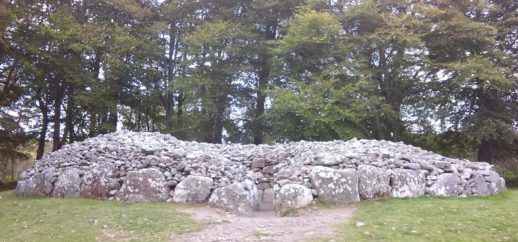
- Gwyddfa – Now used to mean Burial Chamber – but literally a place of knowledge, for the burial of, or meetings of, people with knowledge, or the ‘giants’ of the time, hence Yr Wyddfa or Snowdon and Yr Wyddgrug, which is Mold, where there is a large burial barrow.